The Yamas
The First Limb of Yoga: The Yamas

Greetings from Lotus Hot Yoga Columbia! Last month was our inaugural blog post discussing the various definitions of yoga. Hope you had a chance to ponder yours.
This month, we are focusing on the first limb of yoga: The Yamas
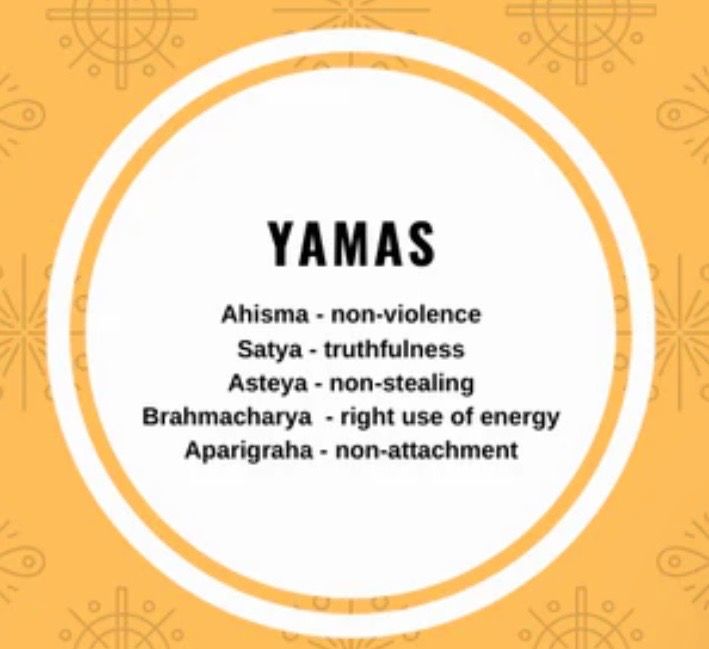
The Yamas are a set of five ethical restraints and universal moral disciplines designed to guide your behavior, thoughts, and relationship with the outside world.
Ahimsa (Non-violence): The practice of non-harming. This encourages compassion in your thoughts, words, and physical actions towards all living things, including yourself.
Satya (Truthfulness): Living and speaking with honesty and integrity. It involves aligning your words with your truth, while still practicing it alongside ahimsa so it remains kind and constructive.
Asteya (Non-stealing): Restraining from taking anything that isn't freely given, including physical objects, time, or energy. It stems from the abundance mindset that you already have enough.
Brahmacharya (Moderation / Right use of energy): Managing your physical and sensual energy. In modern contexts, this is often interpreted as avoiding excess, curbing addictions, and staying grounded rather than being drained by external desires.
Aparigraha (Non-possessiveness / Non-attachment): Practicing non-greed and letting go of the need to hoard or cling to things, outcomes, or comparisons
One of my favorite books unpacking the Yamas and Niyamas (the second limb and the subject of July’s blog) is by Deborah Adele:
https://www.amazon.com/Yamas-Niyamas-Exploring-Ethical-Practice/dp/0974470643/ref=sr_1_1?dib=eyJ2IjoiMSJ9.vEpRY7GfqSuBIaonJIgbN4baUvYKcGNYPLg3LPSe3V_IDBQ8muz6ChRN4_poZL5OAx6cYsLwxFXT8emjiyXcvlUJuBb6hBSnUNj5jFAyI3c.SId-Bn7gihd3SeipotKZGvNrEh6CEgDm65kpwHfit3M&dib_tag=se&hvadid=792639862975&hvdev=c&hvexpln=67&hvlocphy=1020268&hvnetw=g&hvocijid=416695321772337295--&hvqmt=e&hvrand=416695321772337295&hvtargid=kwd-375245256907&hydadcr=4821_13549427&keywords=deborah+adele+yamas+and+niyamas&mcid=433db9e15e06313db63a89fbf66df804&qid=1781468166&sr=8-1
These five restraints or ways of interacting with both the outside world and yourself, can be applied both on and off the mat. One of our teachers, Samantha Pleimann, reflected on Ahimsa and its importance in her life.
The contemplation and practice of Ahimsa changed my life. I never had a problem applying non-violence to other people/beings. But that’s where it seemed to start and end. I saw I could apply it to everything and everyone but myself. That needed to change, or I would continue to seek approval and fulfillment through all of the wrong things–and it would be never-evending–and I would never know peace. Violence is not just physical harm–it’s the harsh thought, the impossible standard, the constant self-surveillance, the belief that worthiness exists somewhere in the future. With that regard, Ahimsa poses some radical questions: What if I stopped treating myself like a problem to be solved? Can I love myself for all that I am without trying to categorize parts of ME as “good” or “bad”? Can I care for myself without trying to improve myself? Ahimsa asks you to see the difference between forcing vs. allowing, controlling vs. trusting, fixing vs. nurturing. Ahimsa says “you are allowed to be here now.” Not after you have the dream job, not after you buy the house and the car, not after you lose 10 pounds or make a certain amount of money. Just now–as you are. This is not weakness or complacency–it is gentleness and there is a difference. Ahimsa is a reverence for life. When practiced, it becomes how you tough people, how you speak, how you create, how you move, how you feed yourself, how you meet the world. Peace arrives when you can love yourself, and the freedom that comes from there is immeasurable. The Yamas all lead toward freedom, but Ahimsa is often the doorway. I am forever grateful for this shift in perspective. And while this shift had a beginning–it will never have an end, as it is an ongoing and ever-expanding practice that I happily embrace and apply to all areas of life.
The Yamas ask us to take a look at our lives and how we can treat others and ourselves, both on and off the mat, with care and reverence.
Which Yama resonates most with you?
Ponder that and let us know the next time you are in the studio.
See you on your mat!
Jai!